A few years ago, I almost threw my smartphone into the ocean. Not literally, but the urge was incredibly real. My brain felt like a web browser with 37 tabs open, all frozen, and none of them responding. Between late-night scrolling, random video reels, and jumping between apps every ten seconds, I was anxious, restless, and twitchy all day long.
So, I decided to do a digital detox. I deleted every app, powered down my phone, and went completely off the grid for a week. I thought I had fixed my life. But the moment I turned my phone back on, I was hit with hundreds of unread messages and missed calls. The anxiety hit me like a truck. Within two days, I was right back to scrolling at midnight like a lab rat pressing a dopamine lever.
The detox failed because I treated my phone like the enemy, rather than fixing my own habits.
Over the past year, I changed my approach. I realized you do not need to go live in the woods for a month. A targeted, 48-hour weekend break is enough to hit the reset button on your brain. Research actually backs this up, showing that just two days without constant notifications can measurably drop your stress hormones.
Here is exactly how I plan and execute a weekend screen break, including the tools I use to stop myself from cheating and the weird offline hobbies that keep me sane.
The Friday Night Setup: Lock Yourself Out
Willpower is useless when you are bored. If your phone is sitting on the coffee table, your hands will automatically reach for it. You have to use software to create hard barriers.
Before I go to bed on Friday, I set up my devices so that getting online is incredibly annoying.
If you use an iPhone: Apple’s Screen Time has a major flaw: the “Ignore Limit” button. It is way too easy to give yourself 15 more minutes. To fix this, I create a custom Focus mode that only lets calls from my immediate family come through. Then, I use the “Hide from Home Screen” feature for every single social media and news app. Hiding the actual app icon stops the visual trigger, which can cut down your unconscious screen checking massively.
If you use an Android: Android’s Digital Wellbeing is slightly better for strict limits. I open the dashboard, find my worst time-wasting apps, and set the App Timer to zero minutes. The most important step is toggling on the setting that says “Block app when time is up.” Then, I go into the parental controls and disable the ability to ignore the timer. This creates a hard wall.
The Hardcore Option: Because I work on a computer, I sometimes find myself opening a laptop just to check a forum. To stop this, I use a blocking app called Freedom. It completely severs my access to distracting websites across my phone and laptop at the same time.
If I really need to stay focused on a specific offline task, I also use the Forest app. You set a timer, and a little virtual tree starts growing on your screen. If you pick up your phone and switch apps, the tree dies. I usually start with small 15 to 20-minute sessions just to keep myself grounded.
Surviving the First 12 Hours
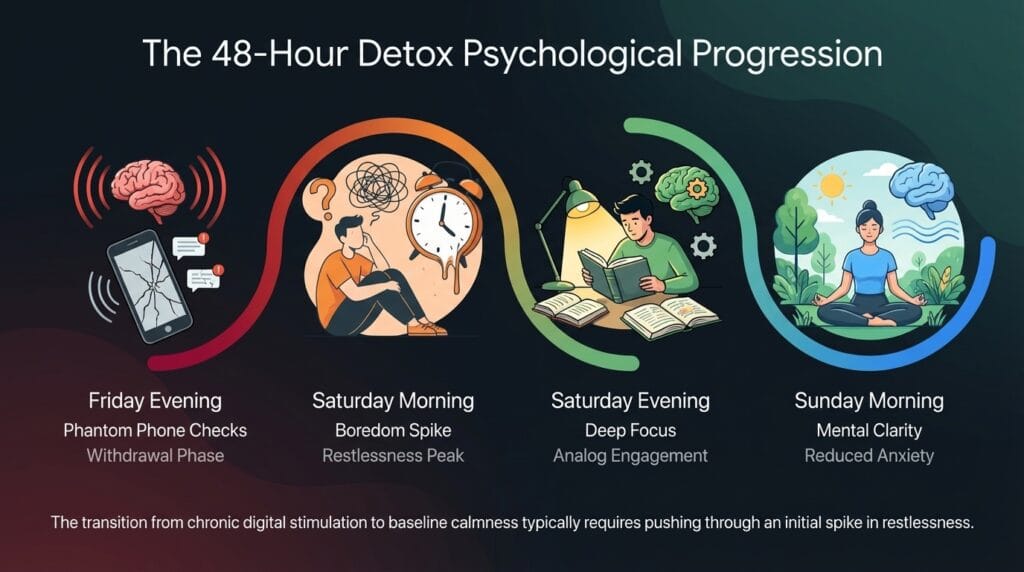
Saturday morning is always the roughest part. The first few hours feel incredibly uncomfortable. You will notice “phantom buzzing”—the feeling that your phone is vibrating when it isn’t. I constantly find my hand reaching for my pocket out of pure muscle memory.
During my first failed attempts, I tried to beat this uncomfortable feeling by becoming super productive. I would try to deep-clean my entire apartment or read a massive textbook. But that is just substituting one stressful distraction for another.
You have to let yourself be bored. Boredom is the feeling of your nervous system slowing down. Get a cheap battery-powered alarm clock and a real wristwatch so you do not have an excuse to pick up your phone to check the time. Sit on the couch with your coffee and just look out the window. Let the jittery feeling pass.
Finding Your “Analog Anarchy”
By Saturday afternoon, the panic fades and the boredom peaks. This is where you have to fill the gap, otherwise, you will turn the Wi-Fi back on. My partner and I started dealing with this by embracing what we call “Analog Anarchy.”
Basically, we do the most random, hands-on activities possible. Social media feeds you passive entertainment, so you need to force your brain to make its own fun.
Here are a few things that actually work for me:
The Paper Notebook: I bought a small, thin Moleskine notebook and a fountain pen. Writing by hand feels tactile and real. Ideas leave your head and take up physical space. I use it to write down random thoughts, make lists, or sketch terrible drawings.
Dumb Crafts: We bought a cheap coloring book and some markers. We even went for a walk, collected rocks, and glued googly eyes on them. Do not judge it until you try it. Keeping your hands busy completely kills the urge to swipe a screen.
Kitchen Chaos: We try to cook meals, like homemade pasta, without looking up a single recipe online. It is mostly trial and error, making a huge mess, and relying on taste rather than a video tutorial.
The Location Shift: Getting Out of the House
Sometimes, your house is the trigger. If I sit in the exact chair where I normally watch YouTube, my brain expects YouTube. The most successful screen-free weekend I ever had was when I physically left my normal environment and went on a road trip.
I traveled to the Dera Ghazi Khan district in Southern Punjab. When you do not have a map app or a restaurant review app to guide you, your physical senses completely take over.
Instead of reading the morning news in bed, I walked down to the bazaar. I found a place called Pathar Halwai and stood on the street eating fresh kachori and suji ka halwa. The noise of the street vendors, the smell of the food, and the heat of the morning demanded all my attention. I did not even think about my phone.
Later, we drove up to Fort Munro, a hill station located in the Sulaiman Mountains at over 6,400 feet. The air was cool, and we spent hours just walking around Yadgar Lake and watching the sunset over the rocky cliffs.
For dinner, we navigated the local markets in Kot Chutta and tracked down Gujar beef pulao and a regional specialty called Doli Roti, which is a unique fried wheat bread. Eating street food requires you to be present. You are dodging traffic, talking to vendors, and tasting spices. You replace the cheap dopamine of a screen with the high sensory input of the real world.
Mapping Digital Habits to Physical Replacements
Sunday Night: Turning the Phone Back On
How you turn your devices back on dictates whether your weekend was a success or a waste of time. If you power up your phone on Sunday night and immediately open a video feed, your stress levels will spike instantly.
Here is the step-by-step re-entry plan I use to avoid the panic:
Start in Airplane Mode: I turn the phone on but leave it disconnected from the network. I use this time to check any photos I took or notes I wrote in my offline apps.
Filter the Noise: When I finally turn on the Wi-Fi, I ignore all social media alerts. I only open my text messages to reply to actual human beings—my friends and family.
Run a Quick Audit: After a few days away, you become very sensitive to digital noise. If I open an app and immediately feel bad, I pay attention to that. I unfollow accounts that make me feel envious or annoyed.
Wait on Social Media: I leave all scrolling apps completely untouched until Monday afternoon. There is no reason to ruin a calm Sunday night by reading the news.
Taking a 48-hour break will not fix everything in your life. But when I stick to this routine, I wake up on Monday feeling incredibly calm. My thoughts are slower and more organized. I can stand in line at the grocery store without frantically checking my pockets.
You do not need to book an expensive wellness retreat to feel better. You just need to set some hard software limits, grab a paper notebook, and give yourself permission to exist offline for a couple of days.