Let’s be completely honest for a second: the whole “wake up at 4:00 AM, take an ice bath, and drink celery juice” advice that floods social media feels a lot like a cult. Most of those viral videos are selling an aesthetic, not a sustainable lifestyle. If you’re like me, you don’t want to perform for an audience; you just want to wake up without feeling like a zombie and actually get some deep work done before noon.
After spending years testing countless apps, smart home gadgets, and productivity frameworks, I’ve realized something crucial. A highly productive morning doesn’t require misery or sleep deprivation. It requires a system.
When you rely on willpower alone, you fail. Your brain only has so much decision-making energy, and if you waste it trying to figure out what to wear or what task to start first, you’re drained by 9:00 AM. In fact, research from the University of Wyoming shows that just disrupting a standard morning routine—like missing your usual cup of coffee—leaves workers measurably less focused and more mentally exhausted for the rest of the day.
Here is exactly how I built a morning routine that actually sticks, using a mix of biology, smart tech, and aggressive app blockers.
Forget the “5 AM Club”
The biggest mistake I ever made was trying to force myself to wake up at 5:00 AM when my body naturally wanted to sleep until 7:30 AM.
There’s a persistent myth that early risers are inherently more successful. But a successful routine isn’t necessarily an early one. Sleep researcher Matthew Walker points out that waking up at the exact same time every day stabilizes your circadian rhythm and improves cognitive performance far better than simply waking up early.
Even highly successful executives ignore the 5 AM rule. Google CEO Sundar Pichai openly admits he is “not a morning person,” and Oprah Winfrey refuses to use an alarm clock entirely. The key is finding your biological prime time and building your routine around it.
Fix the Biology First: The Huberman Protocol
Before we get to the tech hacks, we have to fix the biological foundation. You can have the best to-do list app in the world, but if your hormones are out of whack, you’re going to feel terrible.
I completely changed how my mornings feel by adopting Dr. Andrew Huberman’s sunlight protocol. The rule is simple: get outside and view natural sunlight within 30 to 60 minutes of waking up.
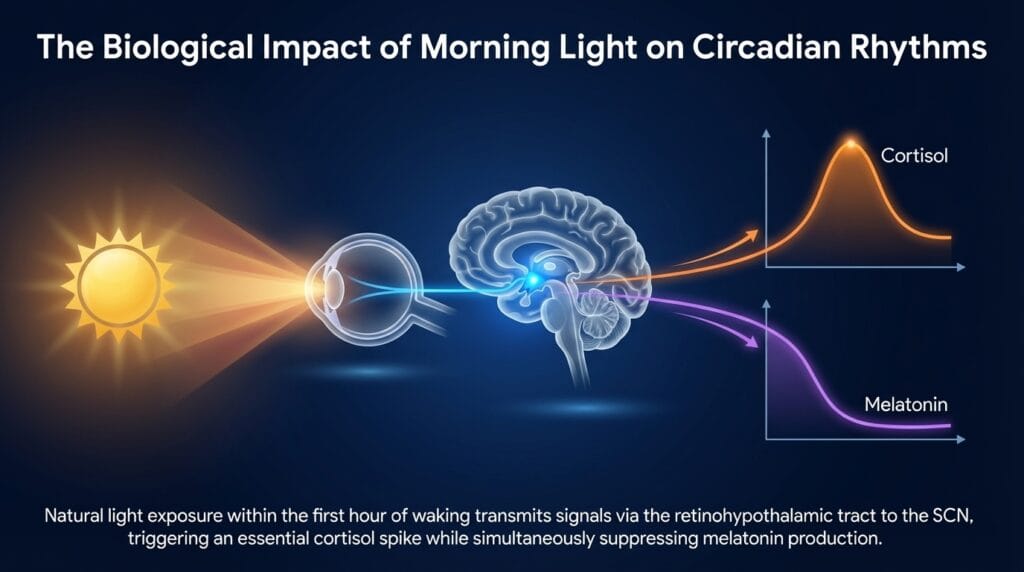
This light exposure hits your eyes and sends a signal directly to your brain’s biological clock. It triggers a healthy, natural spike in cortisol—which acts as an energy-deploying signal to wake you up—and simultaneously sets a timer for melatonin to release later that night so you can actually fall asleep.
Even on cloudy days, spending 15 to 20 minutes outside works wonders. I usually pair this with a quick walk around the block. The physical movement creates “optic flow”—the visual perception of objects passing by—which neurologically quiets the circuits in your brain responsible for stress. Add a massive glass of water with some electrolytes when you walk back through the door, and you’ve already won the morning.
Defeating the Snooze Button with NFC Tags
Willpower is absolutely useless at 6:00 AM. When my alarm used to go off, my prefrontal cortex—the logical part of my brain—was basically offline. I would hit snooze five times, guaranteeing a rushed, chaotic start to my day.
The only thing that permanently fixed this for me was using NFC (Near Field Communication) tags.
You can buy a pack of cheap NFC stickers on Amazon for a few dollars. Using an app like Sleep as Android or Alarmy, I set an alarm that cannot be silenced, snoozed, or bypassed until my phone physically scans a specific NFC tag.
Here is the trick: do not put the tag on your nightstand. I stuck my NFC tag to the top shelf of my bathroom cabinet. When the alarm goes off, I am forced to get out of bed, walk across the house, turn on the bathroom light, and physically tap my phone to the sticker. By the time the alarm stops, I’m already out of bed and the sleep inertia is shattered. It’s incredibly annoying in the moment, but it boasts a 100% success rate.
The Smart Home “Parabolic Sunrise”
If you hate the jarring sound of an alarm clock, you can use smart home tech to wake up naturally. I use Home Assistant (an open-source platform) combined with smart bulbs to create a “parabolic sunrise”.
Auditory alarms spike your adrenaline. Instead, I have an automation that starts 45 minutes before I actually want to wake up. The smart bulbs in my bedroom turn on at just 1% brightness in a deep, warm red. Over the next 45 minutes, the script slowly increases the brightness and shifts the color temperature to a bright, cool white. Because the light gently suppresses melatonin, I usually wake up naturally about 10 minutes before my actual audio alarm ever goes off.
Locking Down Your Phone with iOS Shortcuts
The single most destructive thing you can do for your productivity is check your phone in bed. Scrolling social media or reading work emails within the first hour of waking up floods your brain with cheap dopamine and puts you in a reactive, stressed state before you’ve even brushed your teeth.
To stop myself from doing this, I built a brutal iOS Focus Mode routine using Apple’s Shortcuts app.
Here is how you can set up this exact automation to protect your morning:
Open the Shortcuts app on your iPhone and go to the Automation tab.
Create a new automation triggered by Time of Day (e.g., 6:30 AM) or when your wake-up alarm is stopped.
Add the Set Focus action and turn on a custom “Morning Work” profile. I have this profile configured to hard-block every single app notification except for calls from my immediate family.
Add the Set Brightness action and drop it to 5%. If I try to look at my phone in the dark, the screen is too dim to comfortably read articles or scroll Instagram.
Add the Play Podcast action to automatically start my favorite daily news brief.
With one automation, my phone is transformed from a distraction device into a locked-down productivity tool the second I wake up.
The App Stack for Deep Work
Once I actually sit down at my desk, I don’t want to waste time figuring out what to do. My mornings are strictly reserved for “Deep Work”—usually writing blog content, coding, or strategizing. To keep things moving, I rely on a very specific, minimal app stack:
Breaktime: This is the only app blocker that actually works for me. If I try to open a distracting website, Breaktime forces a mandatory 30-second waiting period. Nine times out of ten, that tiny bit of friction is enough to make me close the tab and get back to work.
Notion + Zapier: Notion acts as my second brain for daily task lists, while Zapier runs in the background to connect everything. When I check a task off in Notion, Zapier logs it automatically. No manual data entry means more time for actual work.
SayTXT: I use this AI app to turn PDFs and long industry articles into audio. I listen to them while I’m making coffee or doing morning stretches, turning dead time into productive learning.
Let Wearables Dictate Your Schedule
I used to push through exhaustion to stick to a rigid to-do list, which usually resulted in burnout. Now, I let my wearable tech dictate my schedule.
I wear an Oura Ring to track my overnight heart rate variability (HRV), sleep architecture, and body temperature. The app gives me a “Readiness Score” every morning. But instead of just looking at the number, I actually change my day based on it.
If my readiness score is in the high 80s, I tackle my hardest, most cognitively demanding tasks immediately. But if my sleep was terrible and my score is hovering in the 60s, I know my brain isn’t ready for deep work. I use tools like Lifestack, which syncs with my Oura data, to dynamically rearrange my schedule. On low-recovery days, the system suggests doing simple administrative tasks in the morning and pushing heavy lifting to the late afternoon after a midday walk. Planning your day around your actual biological readiness is a complete game-changer.
The Night Owl Exception
If you’re a night owl who naturally gets a burst of energy at 10:00 PM, trying to force a 6:00 AM productivity sprint is a waste of time. For remote workers who peak late, a successful morning routine actually happens the night before.
I have a friend who writes code until 1:00 AM because he loves the uninterrupted quiet of the “Second Day”. For him, the morning routine is entirely about evening prep. Before he closes his laptop at night, he writes down the exact three tasks he needs to tackle the next day, closes all his browser tabs, and clears his physical desk.
When he finally wakes up at 9:00 AM, groggy and tired, he doesn’t have to make a single decision. He just sits down at a clean desk and executes the list he wrote the night before.
The Mistakes That Will Ruin Your Morning
Even with the best tech, routines fail. Here are the most common traps I’ve fallen into—and how to avoid them:
1. Changing everything at once. You cannot wake up tomorrow and suddenly implement a 5 AM alarm, a cold plunge, a 20-minute meditation, and an hour of reading. It’s neurologically unsustainable. As one productivity coach put it, changing too much at once is like constantly stirring a pond—it never gets calm and clear. Pick one habit, like drinking a glass of water before coffee, and do it for a month before adding anything else.
2. Working from bed. Since remote work became the norm, way too many of us just grab our laptops and start answering emails from under the covers. This is terrible for your posture, but worse, it completely destroys the mental boundary between your place of rest and your place of stress. Get up and change rooms.
3. Sabotaging the night before. Your morning doesn’t start when your alarm goes off; it starts at 10:00 PM the night before. If you engage in “revenge bedtime procrastination” and scroll TikTok until 1:00 AM, your morning is already ruined. I use an app called Cold Turkey to forcibly lock my computer at 11:00 PM, leaving me no choice but to wind down.
At the end of the day, building a routine isn’t about punishment or looking busy. It is simply about standardizing the boring parts of your morning so you can save your mental energy for the work that actually matters. Protect your first hour, use automation to remove friction, and get some sunlight. Once you get those basics right, the rest of the day just falls into place.