USA Visa Sponsorship Jobs 2026: The Comprehensive Guide to High-Salary Roles and Strategic Applications
Looking for a US visa sponsorship job in 2026? I’m not going to sugarcoat it: the entire playbook has flipped upside down over the last year. If you are still relying on the old strategy of blasting your resume to a thousand entry-level jobs and praying for a lucky break in the H-1B lottery, you are going to hit a brick wall.
Between 2025 and 2026, the Department of Homeland Security completely rewired how the system works. It is no longer a random draw where everyone has an equal shot. On top of that, new federal fees—including a staggering $100,000 fee for certain overseas hires—have forced employers to be incredibly picky about who they actually spend the money to sponsor.
But don’t let the scary headlines convince you to give up. Companies are still desperately hiring international talent in tech, healthcare, and engineering because the domestic shortage of skilled workers hasn’t magically disappeared. You just need to change your approach. Let me break down exactly how to navigate this new landscape, beat the applicant tracking systems, and secure a high-paying role that actually wants to sponsor you.
The New Lottery Math: Why Your Salary is Everything
To win in 2026, you absolutely must understand how the government is picking applications. The new DHS rule means your chances of being selected in the March H-1B lottery are directly tied to the Department of Labor (DOL) wage level of your job offer.
Basically, the DOL breaks prevailing wages down into four levels based on experience, education, and the complexity of the role. Under the new system, the higher your wage level, the more times your name gets entered into the selection pool :
Wage Level I (Entry): You get exactly 1 lottery entry.
Wage Level II (Qualified): You get 2 lottery entries.
Wage Level III (Experienced): You get 3 lottery entries.
Wage Level IV (Fully Competent): You get 4 lottery entries.
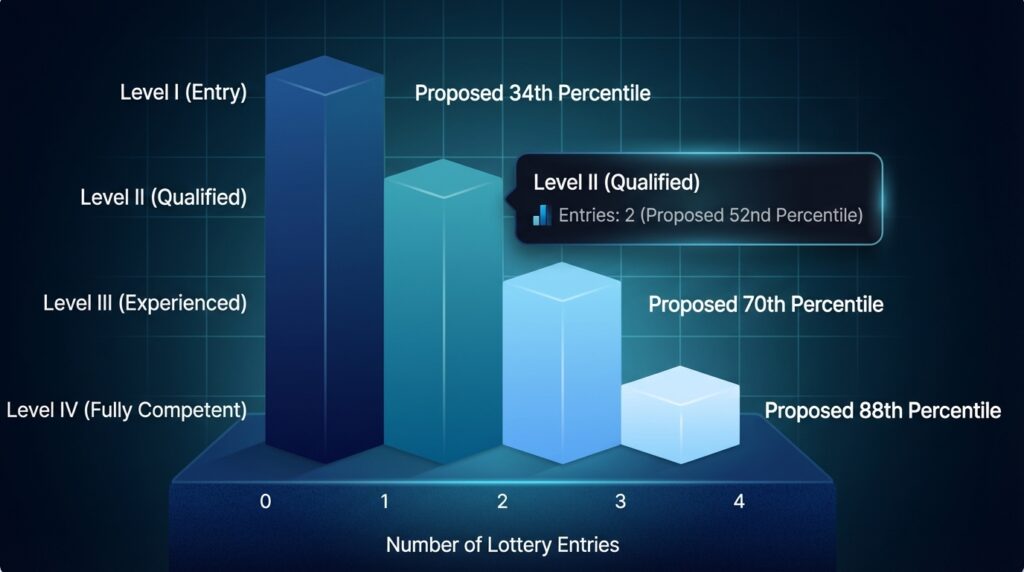
Think about what this actually means. If you manage to secure a Level III salary, you mathematically have triple the chances of someone who settled for a Level I salary.
And here is the real kicker: the DOL also shifted the goalposts for what qualifies as these wage levels. What used to be considered a Level II salary is now effectively the baseline for Level I. Employers have to pay significantly more just to clear the basic legal hurdles. Your entire job hunt strategy should be focused on finding companies that have the actual budget to offer Level III or Level IV salaries, because paying that premium is the only way they can protect their investment in recruiting you.
High-Salary Roles That Are Actually Sponsoring
Despite the highly publicized tech layoffs you hear about, specific roles are still massive magnets for visa sponsorship. Employers are more than willing to deal with the headaches and high fees if you bring specialized, hard-to-find skills to their team.
The Geography Hack in Tech
Software engineers, AI researchers, and data scientists are obviously still at the top of the list. However, geography plays a massive role in your strategy that most applicants completely ignore.
Let’s look at the numbers. An entry-level software developer in San Francisco averages around $119,700, while the exact same role in Austin or Seattle might range between $85,000 and $95,000.
Why does this matter for your visa? Because a $130,000 salary in wildly expensive San Francisco might only count as a Level I wage locally, giving you just one single lottery ticket. But if you negotiate a fully remote job based out of Kansas City or Ohio paying that exact same $130,000, it could easily map to a Level III or IV wage in that specific county. That immediately triples or quadruples your lottery odds. Do not just look at the salary number on the offer letter; look at where the company files its paperwork.
The Healthcare Deficit
The U.S. is facing a chronic, long-term shortage of healthcare workers. Registered nurses (RNs), physical therapists, and medical technologists are heavily sponsored right now.
In high-paying states like California, RNs average around $124,000, while New York averages $110,490. Because the domestic talent pool simply cannot meet the demand, hospitals frequently offer direct H-1B or even EB-3 Green Card sponsorships. Many are even throwing in sign-on bonuses and relocation assistance to get international nurses onto the floor faster.
Beating the ATS bots
One of the biggest mistakes I see smart, highly qualified international candidates make is using beautiful, graphic-heavy resumes. They use fancy templates with dual columns, progress bars for their skills, and custom fonts. These look amazing to humans, but they fail miserably when run through a company’s Applicant Tracking System (ATS). If the ATS bot can’t read your text, the recruiter never even knows you applied.
You have to use purpose-built ATS optimization platforms. This is especially crucial for visa candidates because the bullet points on your resume eventually need to match the “Specialty Occupation” duties your employer will file with the government. If there is a disconnect, you risk getting a Request for Evidence (RFE) later on.
Before you send out another application, run your resume through a scanner. Tools like Jobscan are fantastic for deep, keyword-by-keyword analysis against a specific job description you want to apply for. If you want a platform that uses AI to help write bullet points that actually pass modern parsing tests, Kickresume is currently a top choice.
Pro Tip: If you are an international student currently on OPT, put that right at the very top of your resume. Write something clear like: Authorized to work in the U.S. without sponsorship until May 2028 via STEM OPT. This immediately answers the recruiter’s biggest fear and stops them from tossing your resume into the rejection pile over assumed immediate visa costs.
Handling the “Do You Require Sponsorship?” Question
Eventually, your resume will get picked up, you’ll get on a screening call, and the recruiter will ask the mandatory legal question: “Will you now or in the future require employment visa sponsorship?”
First rule: Never lie on the application portal. If you check “No” just to get the interview, and they later find out you need an H-1B, your offer will be rescinded instantly when they ask for your I-9 paperwork. Instead, you need to reframe the conversation entirely based on your current status.
If you are currently on STEM OPT: Don’t sound apologetic. Answer confidently: “I currently have unrestricted work authorization through my student visa until 2028. For the next three years, I do not need any legal filings, fees, or sponsorship from you. My goal right now is to come in and deliver immediate value to the engineering team. If we both love working together after a few years, I will eventually require sponsorship down the road.” Notice what this does? It pushes the “expensive” visa problem years into the future. It allows the recruiter to pass you to the hiring manager because you don’t cost anything extra today.
If you are applying from overseas or your OPT is expiring soon: Be direct and show you know how the system works. “Yes, I will need employer sponsorship. I know the H-1B process recently changed to favor higher-wage candidates, and I am also open to exploring an O-1 visa or an EB-2 process if that aligns better with your company’s legal framework.” This proves you aren’t just blindly asking for a visa. It shows you understand the legal landscape, which actually puts HR at ease.
Watch Out for These Costly Legal Traps
Even incredibly smart people mess up the paperwork. Immigration law is unforgiving. Here are two massive traps that ruin careers every year:
The CPT Expiration Trap: Let’s say you are a student working on Curricular Practical Training (CPT) and your employer finally files an H-1B for you in June. Do not assume you can just keep working until October when the H-1B starts. The federal “Cap-Gap” rule automatically extends OPT work authorization, but it does not legally extend CPT. If your CPT expires in August, you must stop working immediately, even if your H-1B is pending. Continuing to work past that date is a federal violation and can get your visa revoked.
Forgetting Your STEM OPT Backup: Winning the H-1B lottery feels like winning the jackpot, but it is just permission to file the paperwork. It is not an approved visa. A lot of students win the lottery in March and get lazy, deciding not to apply for their 24-month STEM OPT extension to save a few bucks. This is a terrible idea. If your H-1B gets hit with a nasty RFE, gets denied, or your company suddenly lays you off in August before the visa activates, that STEM OPT card is the only safety net keeping you legally in the country. Always file your backups.
Bypassing the Lottery Entirely
If you absolutely hate the idea of relying on a lottery—even a wage-weighted one—there is a backdoor. Look into Cap-Exempt employers.
Universities, non-profit research organizations, and government research labs (like the NIH or Department of Energy labs) are legally allowed to sponsor H-1B visas year-round. They bypass the 85,000 annual limit completely, and they don’t have to wait for the March registration window.
You probably won’t make Silicon Valley tech money working for a university hospital, but you will get a guaranteed, stress-free pathway to a work visa without the sleepless nights waiting for lottery results.
Final Thoughts
Landing a sponsored job in 2026 takes way more effort than it did five years ago, but the path is actually much more predictable now. Stop mass applying. Focus your energy on verifying employers through databases like H1BGrader , optimizing your resume for the ATS bots, and specifically targeting salaries and locations that boost your lottery odds under the new rules. Treat your job hunt like a highly strategic project, and you’ll find the companies that are willing to invest in you.
Publisher Note: The internet is full of scammers and fake agencies promising “guaranteed” visa sponsorships for an upfront fee. Always remember that under U.S. law, legitimate employers pay the H-1B visa fees, not the candidate. As per standard digital advertising policies regarding government documents and services, please note that third-party job boards, blogs, and advisory sites are not official government websites. Always verify filing dates, prevailing wage levels, and fee structures directly at USCIS.gov and consult with a verified immigration attorney for your specific case.